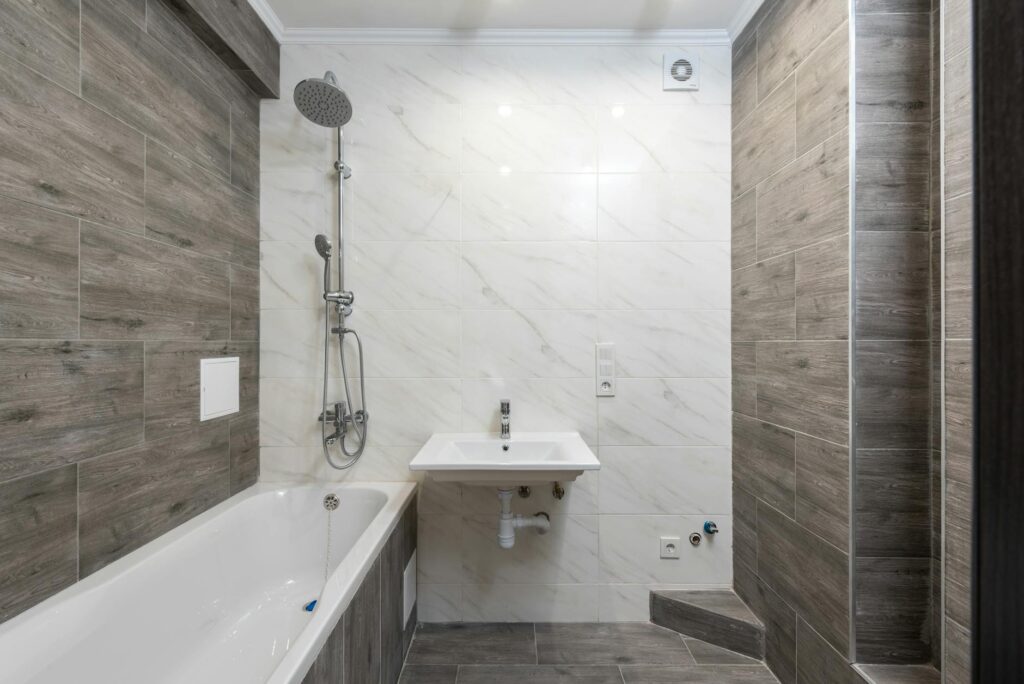
Quick answer: a bathroom renovation in Australia costs about $8,000–$18,000 for a cosmetic refresh, $18,000–$35,000 for a full mid-range renovation (what most people mean by “renovating a bathroom”), and $35,000–$55,000 for high-end finishes. Luxury custom builds run from $55,000 to $90,000 or more. Sydney and Darwin sit about 10% above these figures; Adelaide and Hobart about 5% below.
This guide brings together our city-by-city, budget-level, ensuite, small-bathroom and luxury bathroom guides into one place. For a figure matched to your size, finish level and city, use our free bathroom renovation cost calculator.
Bathroom renovation cost by renovation level
The biggest driver of cost is how far you go: keeping the existing layout and surfaces is far cheaper than stripping back to the frame. Figures are for a medium bathroom (4–6 m²) and include labour and materials.
| Renovation level | Typical cost | What it usually includes |
|---|---|---|
| Budget — cosmetic refresh | $8,000–$18,000 | Same layout. New vanity, tapware, toilet and accessories; regrout or retile selected areas; paint and lighting. |
| Standard — full mid-range | $18,000–$35,000 | Strip-out to the frame. New waterproofing, wall and floor tiles, shower, vanity, toilet, tapware, exhaust fan and lighting. |
| Premium — high-end finishes | $35,000–$55,000 | Full renovation with large-format or natural-stone tiles, frameless screens, wall-hung toilet, custom joinery and some layout changes. |
| Luxury — custom build | $55,000–$90,000+ | Designer fittings, underfloor heating, freestanding bath, moved walls or windows, and architect or designer involvement. |
“Average”, “typical” and “full” bathroom renovation quotes almost always sit in the standard band. If a quote for a full renovation comes in well under $18,000, check whether waterproofing, tiling and plumbing are all included.
Cost by bathroom size
Bigger rooms need more tiles, waterproofing and labour, but small bathrooms don’t get much cheaper: waterproofing, plumbing, compliance certificates and minimum trade call-outs apply regardless of size. These are standard-level (full mid-range) figures.
| Bathroom size | Standard renovation | vs medium |
|---|---|---|
| Small (4 m² or under) | $15,500–$30,000 | −15% |
| Medium (4–6 m²) | $18,000–$35,000 | — |
| Large (6–10 m²) | $22,500–$44,000 | +25% |
| Extra large (10 m²+) | $27,000–$52,500 | +50% |
Ensuites and powder rooms usually fall in the small band. A main bathroom with a separate bath and shower tends to sit at the top of its range.
Ensuite and small bathroom renovation cost
Ensuites, powder rooms and bathrooms of 4 m² or less cost only about 15% less than a medium bathroom, because waterproofing, plumbing, compliance certificates and trade call-outs don’t shrink with the room.
| Renovation level | Ensuite or small bathroom | Medium bathroom |
|---|---|---|
| Budget — cosmetic refresh | $7,000–$15,500 | $8,000–$18,000 |
| Standard — full mid-range | $15,500–$30,000 | $18,000–$35,000 |
| Premium — high-end finishes | $30,000–$47,000 | $35,000–$55,000 |
Renovating vs adding an ensuite. Renovating an existing ensuite follows the ranges above. Adding a new ensuite costs more: it needs new drainage and water connections, framing, waterproofing and ventilation, and sometimes approval if walls, windows or drainage change. Get the plumbing route checked before committing, especially on a concrete slab or upstairs.
Making a small bathroom work harder:
- A wall-hung vanity and toilet show more floor and make cleaning easier.
- A frameless or fixed glass screen keeps sightlines open; skip the bath if you rarely use it.
- Large-format tiles mean fewer grout lines and a calmer look.
- A recessed shower niche and a mirrored shaving cabinet replace bulky storage.
- Good ventilation matters even more in a small room: duct the exhaust fan outside.
- A cavity sliding door saves swing space in tight ensuites.
Luxury bathroom renovation
Luxury custom bathrooms typically start around $55,000–$90,000+ for a medium room: about $60,500–$99,000+ in Sydney and Darwin, and $52,500–$85,500+ in Adelaide and Hobart. What pushes a renovation into this bracket:
- Designer or architect involvement, and layout changes such as moving walls or windows.
- Natural stone, large-format porcelain slabs or feature tiling to the ceiling.
- Freestanding baths, double vanities, walk-in showers and custom joinery.
- Underfloor heating, heated towel rails and smart or thermostatic tapware.
- Premium fittings with long lead times, which also affect the timeline.
In a luxury project, the finishes you can see are only part of the cost. Structural changes, waterproofing to a higher standard and the extra labour for detailed tiling make up much of the difference.
Bathroom renovation cost by city
Labour is 40–50% of most bathroom budgets, so local trade rates move the total. The table applies each city’s labour adjustment to the national ranges above.
| City | Budget | Standard | Premium | vs national |
|---|---|---|---|---|
| Sydney | $9,000–$20,000 | $20,000–$38,500 | $38,500–$60,500 | +10% |
| Darwin | $9,000–$20,000 | $20,000–$38,500 | $38,500–$60,500 | +10% |
| Melbourne | $8,500–$19,000 | $19,000–$37,000 | $37,000–$58,000 | +5% |
| Canberra | $8,500–$19,000 | $19,000–$37,000 | $37,000–$58,000 | +5% |
| Brisbane | $8,000–$18,000 | $18,000–$35,000 | $35,000–$55,000 | national average |
| Perth | $8,000–$18,000 | $18,000–$35,000 | $35,000–$55,000 | national average |
| Gold Coast | $8,000–$18,000 | $18,000–$35,000 | $35,000–$55,000 | national average |
| Adelaide | $7,500–$17,000 | $17,000–$33,000 | $33,000–$52,000 | −5% |
| Hobart | $7,500–$17,000 | $17,000–$33,000 | $33,000–$52,000 | −5% |
Newcastle and Geelong aren’t separately adjusted in our calculator; quotes there generally track the national figures, with inner and coastal suburbs at the upper end.
What’s different in each city
Sydney. Apartment bathrooms often have waste pipes running through the concrete slab, so moving a toilet can mean core drilling or a macerator pump; check strata by-laws early, as some buildings require approved contractors or engineered waterproofing plans. Coastal suburbs need corrosion-resistant tapware and exhaust fans ducted outside. Western Sydney labour typically runs below the inner-city rate.
Melbourne. Heritage overlays in inner suburbs can add weeks and consultant fees if work affects the exterior, such as new windows or vents. Damp winters make a properly ducted exhaust fan one of the best-value upgrades for avoiding mould.
Brisbane. Character overlays apply in many inner suburbs, and narrow streets can add a site-access loading to quotes. Homes built from the 1970s to the 1990s should be tested for asbestos before demolition. Your plumber lodges the plumbing compliance paperwork with council; make sure it’s in the quote.
Perth. Most post-1980s homes are on concrete slabs, and moving drains means cutting the slab, sometimes into limestone. Keeping the existing layout is the biggest saving available. Pre-1990 brick-and-tile homes commonly have asbestos sheeting behind bathroom tiles.
Adelaide. Heritage suburbs such as Norwood, Unley and Burnside may need council sign-off for changes that affect heritage elements. In solid stone and brick homes, retrofitting exhaust ducting costs more than in framed homes.
Canberra. Cold winters make underfloor heating and heated towel rails popular additions. A small trade pool means lead times can stretch to one to two months in spring and summer, so book early.
Gold Coast. High-rise apartments often charge building-management fees for lift use and restrict work hours and delivery windows. Within a couple of kilometres of the beach, choose marine-grade or stainless fittings.
Newcastle. Beachside suburbs face the same salt-air corrosion as other coastal areas. Character homes in the inner suburbs are often pre-1990, so budget for asbestos testing.
Geelong. Older homes on timber stumps may need floor reinforcement to carry tile weight; a structural inspection before tiling is cheap insurance. Newer estates on slabs are simpler to waterproof and tile.
Hobart. Freight to Tasmania adds to the cost of tiles, vanities and bulky fittings from the mainland, so compare local suppliers. Heritage areas such as Battery Point may need approval for external changes.
Where the money goes
On a standard renovation, the budget typically splits like this:
- Labour (40–50%) — plumber, electrician, waterproofer, tiler and carpenter, plus coordination if you use a builder.
- Tiles and tiling — basic ceramic tiles start at around $25–$40 per m²; large-format porcelain and natural stone can reach $100–$200 per m², before laying costs.
- Waterproofing — usually $1,500–$3,000. It must be done by a qualified waterproofer to Australian Standard AS 3740, and it isn’t the place to cut corners.
- Fixtures and fittings — vanity, toilet, shower screen, tapware and accessories. This is where budget and premium renovations diverge most.
- Plumbing changes — moving a toilet, shower or vanity commonly adds $2,000–$5,000, more on a concrete slab.
- Electrical and ventilation — lighting, power points and an exhaust fan ducted to the outside.
Hidden costs to budget for
- Asbestos — many homes built before 1990 have asbestos in wall sheeting, floor tiles or eaves. Testing is cheap; licensed removal can add $1,500–$4,000.
- Rot and water damage — often only found after strip-out, especially under old showers.
- Floor structure — timber floors may need strengthening for heavy tiles or a stone vanity.
- Old plumbing — galvanised or cast-iron pipes in older homes may need replacing once walls are open.
- Strata and access costs — lift bookings, approved-contractor rules and restricted hours in apartments.
- Contingency — keep 10–15% aside; most renovations uncover something.
DIY vs hiring professionals
Plumbing, electrical work and waterproofing must be done by licensed trades in every state, and those trades issue the compliance certificates you’ll need for insurance and resale. Where DIY can save money is the unlicensed work: demolition (once any asbestos has been cleared), painting, installing accessories and cleaning up. Many homeowners save a few thousand dollars this way without risking the parts that matter.
If you manage the trades yourself instead of using a builder, you avoid the builder’s margin but take on the scheduling, and one trade running late can hold up the rest.
How to reduce your bathroom renovation cost
- Keep the layout. Leaving the toilet, shower and vanity where they are is the single biggest saving.
- Tile to practical heights. Full-height tiling in a secondary bathroom adds cost with little benefit.
- Mix and match finishes. Spend on the things you touch every day (tapware, shower screen) and save on wall tiles.
- Consider a refresh first. If the waterproofing is sound, a cosmetic update may be all you need.
- Get three itemised quotes. Compare like for like, including waterproofing, compliance certificates and rubbish removal.
How long does a bathroom renovation take?
A standard bathroom renovation typically takes three to five weeks from strip-out to final clean, depending on trade availability, tiling complexity and whether the layout changes. Waterproofing membranes need curing time before tiling, which is one reason bathrooms take longer than their size suggests.
Do you need council approval?
Most like-for-like bathroom renovations don’t need council approval. Moving walls, windows or drainage, adding floor area, or working on a heritage-listed property or in a heritage area can trigger permits. Check with your local council, and use licensed, insured trades for waterproofing, plumbing and electrical work.
FAQ
What is the average cost of a bathroom renovation in Australia?
Most full mid-range bathroom renovations cost $18,000–$35,000 for a medium bathroom. Cosmetic refreshes start around $8,000, and premium renovations run $35,000–$55,000.
Can you renovate a bathroom for $10,000?
Yes, if you keep the layout and the existing waterproofing is sound. $10,000 typically covers a new vanity, toilet, tapware, accessories, paint and some retiling, but not a full strip-out.
Why doesn’t a small bathroom cost much less?
Waterproofing, plumbing, compliance and minimum trade call-outs apply regardless of size, so a small bathroom usually costs only around 15% less than a medium one.
What is the most expensive part of a bathroom renovation?
Labour, waterproofing and tiling usually dominate, followed by premium fixtures. Moving plumbing is the biggest avoidable cost.
How much does an ensuite renovation cost?
Ensuites are usually small bathrooms, so expect the small-bathroom range: roughly $15,500–$30,000 for a standard renovation.
Estimate your own bathroom
Our free bathroom renovation cost calculator gives an instant range for your bathroom size, finish level and city, using the same figures as this guide. Always get detailed written quotes from licensed renovators before committing.